
Naphtha Equivalence as a Decisive Criterion in Plastic Pyrolysis Chemical Recycling
The body content of your post goes here. To edit this text, click on it and delete this default text and start typing your own or paste your own fromPlastic pyrolysis occupies a contested space between waste treatment, fuel production, and material recovery. The technical distinction that increasingly defines its classification is not the presence of thermal cracking itself, but the composition of its liquid output. Specifically, naphtha yield has become the decisive metric separating chemical recycling from energy recovery. This distinction is grounded in petrochemical logic, refinery compatibility, and carbon accounting discipline.
Chemical Recycling as a Feedstock Substitution Concept
Material Loop Closure Versus Energy Dissipation
Chemical recycling is fundamentally about loop closure. The objective is to convert post-consumer or post-industrial plastic waste into molecular intermediates that can re-enter polymer manufacturing. In contrast, processes that primarily generate fuels merely redirect carbon toward combustion, terminating its material lifecycle.
Naphtha occupies a privileged position in this framework. It is not an end-use fuel by design, but a petrochemical feedstock. When plastic pyrolysis oil approximates naphtha in composition and functionality, it can displace virgin fossil-derived streams in steam crackers and polymerization units.
Why Product Identity Matters More Than Process Labeling
Thermal depolymerization alone does not constitute chemical recycling. The decisive factor is whether the output can be used as a chemical raw material without downcycling. Regulators, certification bodies, and polymer producers increasingly evaluate outputs, not process descriptions.
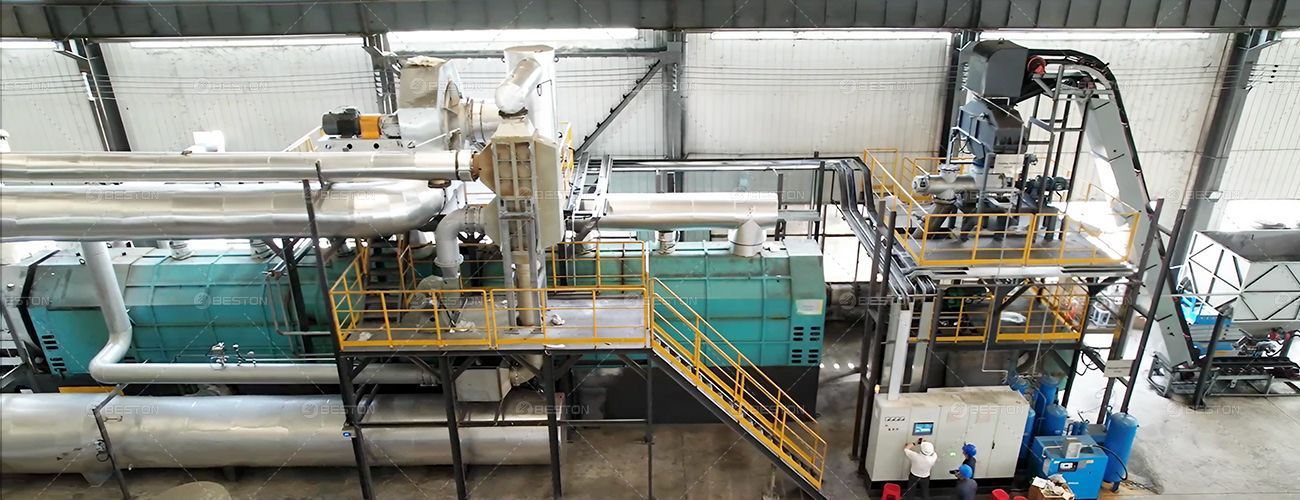
A plastic to oil machine producing high aromatic fuel oil may be technologically sophisticated, yet still fall outside chemical recycling definitions. Conversely, a system optimized for naphtha-range hydrocarbons aligns directly with petrochemical value chains. a different source.
Naphtha as the Reference Benchmark
Functional Role in the Petrochemical Industry
Naphtha is the primary feedstock for steam cracking, where it is converted into ethylene, propylene, and other olefins. These olefins are the building blocks of polyethylene, polypropylene, and numerous derivative polymers.
To qualify as a substitute, pyrolysis-derived liquids must exhibit comparable boiling range, paraffinic content, and impurity profile. This requirement elevates naphtha yield from a secondary performance indicator to a defining criterion.
Boiling Range and Molecular Distribution
From a distillation perspective, naphtha typically occupies the C5–C12 range. Pyrolysis oils that skew toward heavier fractions, waxes, or polyaromatic compounds lack direct cracker compatibility. Excessive light ends, on the other hand, reduce liquid yield and complicate handling.
High naphtha yield implies that the cracking reactions are sufficiently controlled to favor mid-range hydrocarbons rather than indiscriminate fragmentation or over-condensation.
Reaction Pathways That Favor Naphtha Formation
Polymer-Specific Decomposition Behavior
Different polymers decompose along distinct pathways. Polyethylene and polypropylene, when thermally cracked under controlled conditions, naturally favor aliphatic hydrocarbons within the naphtha range. Polystyrene, by contrast, tends to generate styrenics and aromatics. PVC introduces chlorine, which disrupts both product quality and downstream compatibility.
A continuous pyrolysis plant targeting chemical recycling must therefore manage feedstock composition aggressively. High naphtha yield is rarely achievable with mixed plastic streams unless pretreatment and process control are rigorous.
Temperature, Residence Time, and Secondary Cracking
Naphtha optimization is a kinetic exercise. Insufficient temperature leads to wax formation. Excessive temperature promotes gasification and aromatic condensation. Residence time compounds these effects, particularly in vapor-phase secondary reactions.
Systems engineered for chemical recycling typically incorporate rapid vapor removal, staged condensation, and precise thermal gradients. These design choices directly influence the naphtha fraction.
Impurity Control as an Enabler of Naphtha Use
Chlorine, Nitrogen, and Oxygen Constraints
Steam crackers are intolerant of halogens and heteroatoms. Even trace chlorine can corrode equipment and poison catalysts downstream. As a result, naphtha yield is inseparable from impurity management.
Processes that produce nominally naphtha-range liquids but fail impurity thresholds remain functionally excluded from chemical recycling pathways. Dechlorination, adsorption, and feedstock exclusion strategies are therefore structural, not optional.
Stability and Storage Considerations
Naphtha-grade pyrolysis oil must also demonstrate oxidative and thermal stability. Reactive species, unsaturated compounds, and residual oxygenates increase polymerization risk during storage and transport.
A stable product profile reinforces the argument that the output is a chemical intermediate rather than an unstable fuel blendstock.
Certification, Accounting, and Market Recognition
Regulatory Definitions Follow Material Utility
Emerging regulatory frameworks increasingly define chemical recycling by end-use eligibility. If pyrolysis oil is certified for cracker input, it is treated as recycled feedstock. If it is burned, it is treated as fuel, regardless of origin.
Naphtha yield thus becomes a proxy for regulatory acceptance. High yield simplifies certification. Low yield complicates it.
Mass Balance and Carbon Attribution
From a carbon accounting standpoint, naphtha integration enables mass balance attribution. Polymer producers can credibly claim recycled content when pyrolysis-derived naphtha displaces fossil equivalents.
Fuel-range outputs do not provide this leverage. Their carbon is released almost immediately, undermining circularity claims.
Economic Implications of Naphtha-Centric Design
Value Density and Offtake Security
Naphtha commands structurally higher and more stable demand than pyrolysis fuel oil. Offtake agreements with petrochemical buyers provide long-term price visibility and de-risk project economics.
A pyrolysis plant optimized for naphtha yield is therefore economically aligned with chemical recycling markets, not energy markets.
Trade-Offs and Design Constraints
Maximizing naphtha yield is not without cost. Feedstock restrictions tighten. Capex increases due to pretreatment and purification. Operational complexity rises.
However, these trade-offs reflect the difference between waste disposal economics and feedstock production economics. Chemical recycling demands the latter.
Why Naphtha Yield Has Become the Decisive Criterion
The debate over whether plastic pyrolysis qualifies as chemical recycling is no longer philosophical. It is technical and quantitative. Naphtha yield encapsulates feedstock selection, reaction control, impurity management, and end-use viability in a single metric.
When pyrolysis consistently delivers naphtha that can enter steam crackers without dilution or exception, it functions as chemical recycling in both material and economic terms. When it does not, the process remains a form of thermal recovery, regardless of intent.
In this sense, naphtha yield is not merely a performance indicator. It is the boundary line between circularity and combustion, between polymer continuity and carbon release, and between classification ambiguity and industrial acceptance.
